Every year around Ramadan the same question lands in family WhatsApp threads: how much Zakat do I actually owe? Most people search for a Zakat Calculator, type in one number, and close the tab still unsure whether the answer was right.
This guide does the manual version first. It walks through the calculation the way you’d do it by hand with a pen, flags the three places people quietly get it wrong, and then shows you a free Zakat Calculator and tracker that handles the parts a one-off calculation always misses.
If you remember one thing, make it this: a Zakat Calculator is only ever as accurate as the Nisab basis and the metal rate you feed into it.
Table of contents
- What is Zakat and who must pay it
- How to calculate Zakat manually, before you use a Zakat Calculator
- Why gold and silver rates and units trip people up
- Beyond the math: tracking what you actually did
- Hisabio: a free Zakat Calculator and Tracker in one place
- Start your Zakat Calculator free
What is Zakat and who must pay it
Zakat is the third pillar of Islam — an obligatory annual payment on accumulated wealth, not on income. That distinction matters. A person earning ৳200,000 a month who spends all of it owes nothing; a person earning ৳40,000 a month who has saved steadily for years may well owe Zakat.
Zakat becomes obligatory on a sane, adult Muslim whose net zakatable wealth stays at or above the Nisab threshold for a full lunar year. That holding period is called the hawl. Dips during the year generally don’t break it, as long as you were above Nisab at the start and at the end. Any Zakat Calculator worth using has to apply this threshold test before it shows you a number.
The rate is 2.5% — one fortieth of your net zakatable wealth.
Nisab itself is defined in metal, not currency, which is why the threshold moves every year:
- 85 grams of gold, or
- 595 grams of silver
You convert whichever one you’re using into taka at today’s market rate, and that’s your threshold. Some things are simply outside the calculation: the home you live in, the car you drive, your furniture, your clothes, and the tools you use to earn a living. Zakat is on wealth that sits and grows, not on what you use.
One honest caveat before the numbers: schools of thought differ on specific cases — jewellery in daily use, long-term loans, retirement funds. The framework below follows the position most commonly applied in Bangladesh. For your own edge cases, ask a scholar you trust.
How to calculate Zakat manually, before you use a Zakat Calculator
The formula is short. The work is in listing things honestly.
Total zakatable assets − liabilities due = net zakatable wealth. If that figure is at or above Nisab, you owe 2.5% of it.
Step 1: Fix your Zakat date
Pick the lunar date you first crossed Nisab and use it every year. Most people in Bangladesh anchor to Ramadan, which is both practical and rewarding.
Step 2: Add up what’s zakatable
- Cash in hand, bank accounts, and mobile wallets
- Gold and silver in any form — bars, coins, or jewellery — valued at market rate
- Business inventory, valued at what you’d sell it for today
- Shares, mutual funds, and savings certificates
- Money you’ve lent out and genuinely expect to get back
- Rental or side income that’s been sitting in savings
Step 3: Subtract what you owe right now
Deduct short-term debts, overdue bills, and instalments currently due. Do not deduct the entire outstanding balance of a twenty-year loan — only what’s payable in this cycle.
Step 4: Compare the result against Nisab
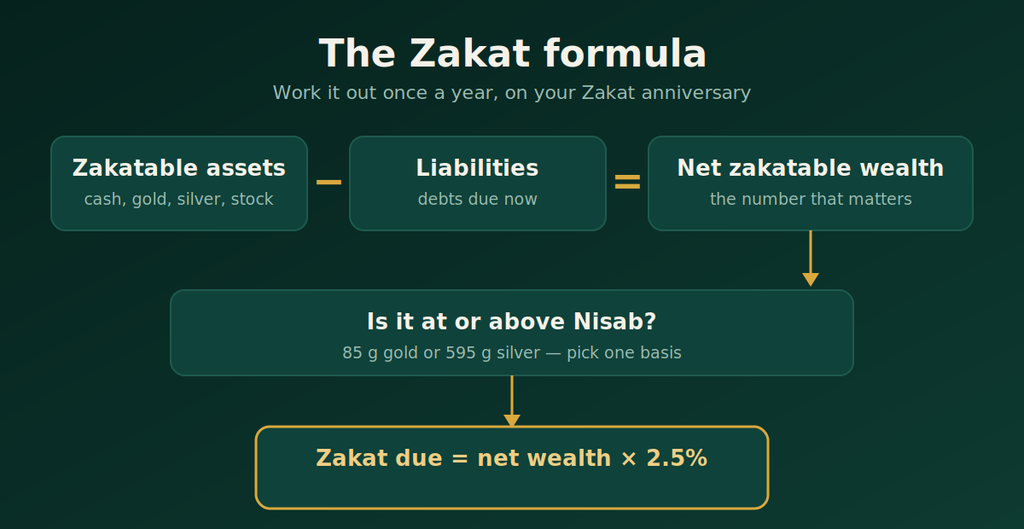
Step 4: Compare the result against Nisab
Here’s a worked example. Assume gold at ৳16,695 per gram and silver at ৳365 per gram — roughly where BAJUS rates sat in September 2026. Use your own date’s rates; these are only for illustration.
- Cash and bank: ৳320,000
- Gold: 4 vori = 46.66 g × ৳16,695 = ৳778,908
- Business stock: ৳150,000
- Loan receivable: ৳50,000
- Liabilities due: − ৳200,000
Net zakatable wealth: ৳1,098,908
Now the two thresholds:
- Gold Nisab: 85 g × ৳16,695 = ৳1,419,075 — this person is below it
- Silver Nisab: 595 g × ৳365 = ৳217,175 — this person is comfortably above it
Step 5: Apply 2.5%
Choose the silver basis and Zakat is due: ৳1,098,908 × 2.5% = ৳27,473. Choose the gold basis and nothing is owed at all.
Step 5: Apply 2.5%
Choose the silver basis and Zakat is due: ৳1,267,100 × 2.5% = ৳31,678. Choose the gold basis and nothing is owed at all.
That single choice is the biggest swing factor in most people’s calculation, and it’s the setting to check first in any Zakat Calculator you use. Silver sets a much lower bar, so more people become liable — and many scholars favour it precisely because it widens the circle of giving. If your wealth is a mix of cash, savings and a little jewellery, silver is the more cautious and more commonly recommended basis.
Why gold and silver rates and units trip people up
This is where a clean spreadsheet quietly goes wrong.
Vori, bhori, and grams
Gold in Bangladesh is bought, sold and remembered in vori (also spelled bhori). Nisab is defined in grams. The conversion is:
1 vori = 11.6638 grams
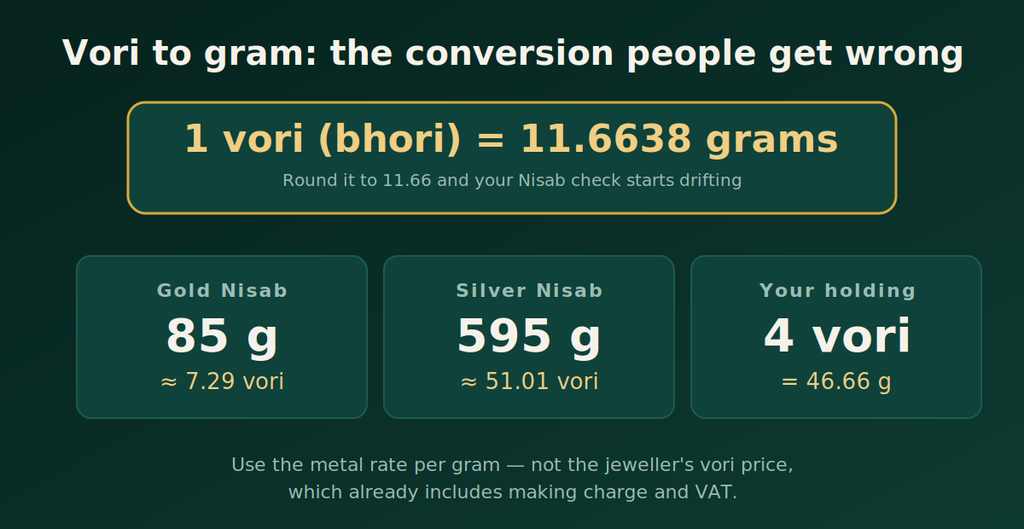
So the thresholds in familiar units are roughly 7.29 vori of gold or 51.01 vori of silver. People round 11.6638 down to 11.66 or even 11.7, and on a seven-vori holding that drift is enough to push a borderline calculation across the line in the wrong direction. Any decent vori to gram Zakat calculator should hold the full figure rather than the rounded one.
Purity matters
Nisab is measured in pure gold content. A 22-karat chain is about 91.6% gold; 21-karat is 87.5%; 18-karat is 75%. Value the metal you actually hold, not the gross weight of the ornament.
The jeweller’s price is not the metal price
A shop’s per-vori rate already includes making charges and VAT. Those are service costs, not gold. For Zakat, use the market metal rate.
You need a rate for the metal you don’t own
This one catches almost everybody. Suppose you own no silver at all — just cash and a few vori of gold — but you’ve chosen the silver basis for Nisab. You still need today’s silver rate per gram, because that’s what defines your threshold. The metal you use to measure the bar is independent of the metal you happen to hold. That’s exactly why a proper Zakat Calculator, and any honest Nisab calculator for gold and silver, asks you for both rates instead of just one.
And rates move daily. Last Ramadan’s number is not this Ramadan’s number.
Beyond the math: tracking what you actually did
Here’s the gap nobody talks about, and the point where a one-time Zakat Calculator stops and real life carries on. You finish the calculation, you get a number, you close the tab — and eleven months later you can’t remember what you valued your gold at, whether your brother chipped in, or which three families received the money.
Zakat is an act of worship with a paper trail. Three things deserve recording.
Who contributed toward the total
In most Bangladeshi households Zakat is pooled. One person calculates, several people contribute, one person distributes. Without a record of who put in how much, next year you’re reconstructing it from memory — and someone’s obligation may have quietly gone unmet.
The permission rule most calculators ignore entirely
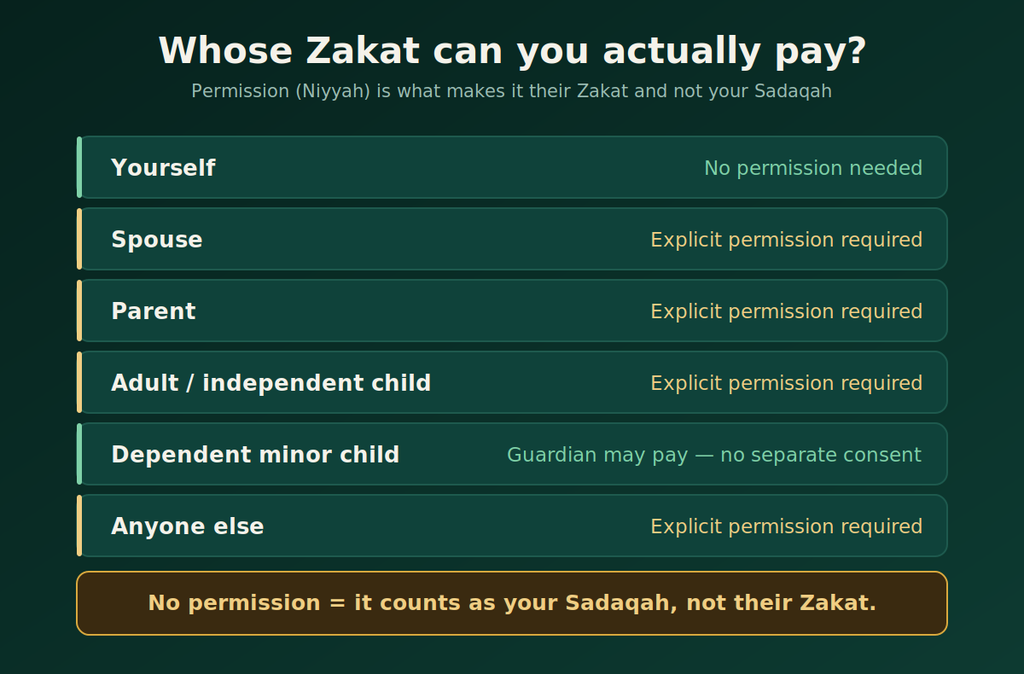
This is the one that genuinely surprises people. If you pay Zakat on someone else’s behalf — your spouse, your parent, your grown-up son — that person’s explicit permission and intention (Niyyah) is required. Without it, the payment does not discharge their Zakat. It counts as your own Sadaqah, and their obligation remains outstanding.
A husband who quietly pays Zakat on his wife’s jewellery, assuming he’s covered it, has given voluntary charity. Her Zakat is still due.
There is one clear exception: a guardian paying on behalf of a dependent minor child acts with existing legal authority, so no separate consent is needed there.
It takes one conversation to fix — but only if you know to have it.
Who received it, and where it sits in your records
Zakat has eight eligible categories defined in the Qur’an. Logging recipients, dates and amounts lets you confirm the full amount was actually distributed, avoid double-giving, and keep your Zakat visible in the same place as the rest of your money — not stranded in a separate notebook.
Hisabio: a free Zakat Calculator and Tracker in one place
I built Hisabio, a personal finance app, and this is the feature I spent the longest getting right — because I’d done this calculation by hand and knew exactly where it breaks down. The Zakat Calculator and tracker covers the whole cycle, not just the arithmetic.
What the Zakat Calculator does
Enter cash, gold and silver, business assets, investments, receivables and liabilities. Gold and silver go in as grams or vori — it converts automatically at 11.6638, no mental math. Pick your Nisab basis (gold or silver), and it checks your net wealth against the threshold and computes the 2.5% due.
Live gold and silver rates
Rates auto-fill from a daily-updated real market source, so you’re not hunting for today’s price mid-calculation. Every rate stays fully editable — override it with your own verified figure whenever you prefer. The number is yours to check, not something the app hides.
Contributors, with the consent rules built in
Add everyone who contributed to a given Zakat Year and tag the relationship: self, spouse, parent, dependent child, independent child, or other. The app applies the correct permission rule for each one — prompting for explicit consent where it’s required, and recognising the guardian-and-minor exception where it isn’t. The rule stops being something you have to remember.
Distribution tracking
Record who received Zakat, when, and how much, so you can see the full amount go out against the amount due. Distributions can optionally be logged straight into your expense records, keeping your Zakat connected to your real finances instead of floating in a separate list.
A Zakat Year that follows the Islamic calendar
Most tools quietly assume a January-to-December year. Hisabio uses a proper Zakat Year tied to the lunar calendar, Ramadan to Ramadan — which is how the obligation actually works, and how most families in Bangladesh already think about it. Each year’s calculation, contributors and distributions stay grouped where they belong, so you can look back at any previous year and see exactly what you did.
How to use the Zakat Calculator in Hisabio, step by step
The quick path: Sign up or log in → Dashboard → Zakat in the sidebar → + New Zakat Year → Calculate → Save → add Contributors and Distributions. Most people are through it in under five minutes.
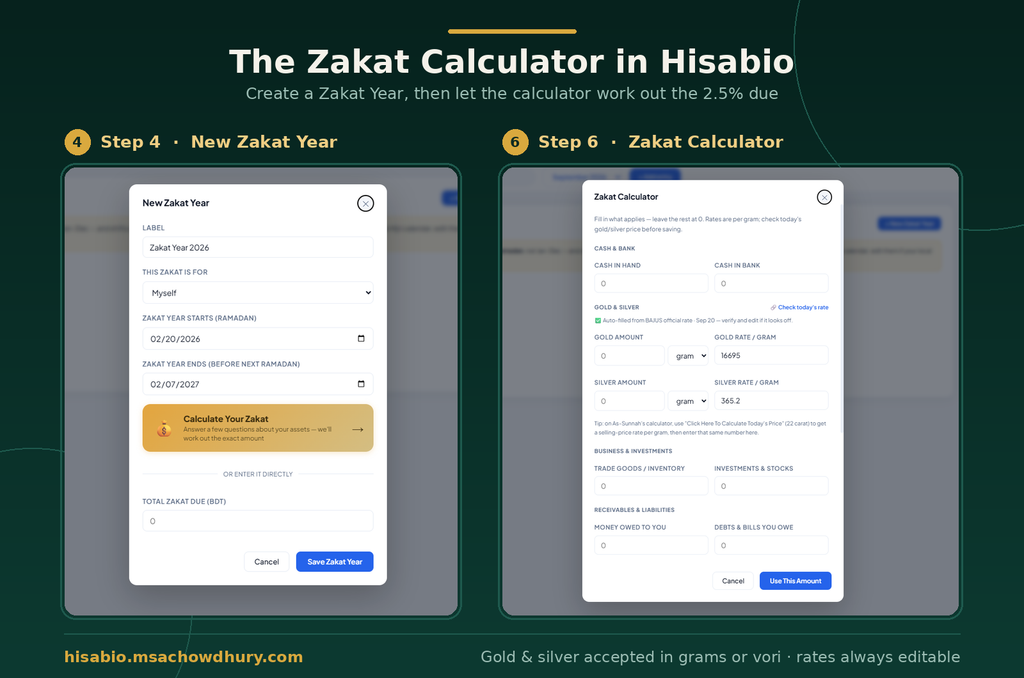
The longer version, in case you want to know what each screen is asking for:
- 1. Create a free account or log in. Zakat lives in the Personal section of Hisabio, not the Business one — so make sure you’re on a Personal account.
- 2. Open Zakat from the Dashboard. It’s in the left sidebar, marked with a crescent-moon icon. On mobile, look for it in the bottom navigation bar.
- 3. Click “+ New Zakat Year.”
- 4. Fill in the basics. A label (auto-suggested as “Zakat Year 2026,” and so on), who this Zakat is for — yourself, spouse, parent, child, or someone else — and the Ramadan-to-Ramadan date range. The dates are auto-suggested and always editable, so if your local moon sighting differs, change them.
- 5. Click the gold “💰 Calculate Your Zakat” banner. That opens the Zakat Calculator. Already know your number from your own workings? Skip the banner and type the total straight into the field underneath, labelled “or enter it directly.”
- 6. Enter what applies to you. Cash, gold and silver, business inventory, investments, receivables, and liabilities. Gold and silver go in as grams or vori — the conversion happens for you. The rate fields auto-fill from a live, daily-updated source; check them against your own figure and edit if you’d rather use yours.
- 7. Choose your Nisab Basis — Gold (85 g) or Silver (595 g). As covered above, this is the choice that moves the answer most.
- 8. Read the result. The Zakat Calculator shows immediately whether you’re above Nisab and the exact 2.5% due.
- 9. Click “Use This Amount,” then “Save Zakat Year.”
- 10. Your Zakat Year appears as a card. Click its title to expand it — everything below happens inside that card.
- 11. Add Contributors if family members or others are paying in. Pick each person’s relationship to you, and the app tells you whether their explicit consent (Niyyah) is required before it counts as their Zakat rather than your Sadaqah.
- 12. Add Distributions as you give the money out — recipient, amount, date. There’s an option to auto-log each one as an expense in your Transactions, so your Zakat sits alongside the rest of your finances instead of in a separate list.
- 13. Mark the year “✅ Complete” once everything is settled and distributed.
Next Ramadan, you open the Zakat Calculator again and start a new Zakat Year — with last year’s contributors, distributions and rates still sitting there for reference.
Start your Zakat Calculator free
You can absolutely do this with a pen and the five steps above — plenty of people do, and understanding the mechanics is worth the hour. But if you’d rather not re-derive the vori conversion every Ramadan, or chase down silver rates for a metal you don’t own, or try to remember whether you asked your mother’s permission last year, a Zakat tracker app exists for exactly that.
Hisabio’s Zakat Calculator is free to try. Run this year’s numbers through the Zakat Calculator, save the calculation, and next Ramadan you’ll open it to find everything already waiting.
May your Zakat be accepted.

Leave a Reply